
What is an ensemble weather model and why is it useful for navigation?
- Francis
- mars 3, 2026
You check the weather forecast before setting sail: southwesterly wind 15 knots, slightly rough seas. Perfect. But how reliable is this forecast? Could it just as easily be 10 knots… or 25? This is exactly the question that an ensemble model answers.
One forecast is good. Thirty-one is better.
A standard weather model such as the GFS produces a single forecast: the best available estimate of the future atmosphere. The problem is that the atmosphere is chaotic—tiny differences in initial conditions can lead to very different outcomes a few days later.
An ensemble model such as NOAA’s GEFS (Global Ensemble Forecast System) takes a radically different approach. Instead of running a single simulation, it runs 31 in parallel:
- 1 control run (gec00): the reference simulation, without perturbation
- 30 perturbed members (gep01 up to gep30): each starts from slightly different initial conditions, simulating the natural uncertainty of observations
Result: instead of a single scenario, you get 31 possible futures. If the 31 forecasts converge, confidence is high. If they diverge, it is a clear signal that the situation is uncertain and caution is needed.
The average GEFS model displays wind and pressure with their standard deviation, providing an overview of the uncertainty.
Average and standard deviation: see the uncertainty at a glance
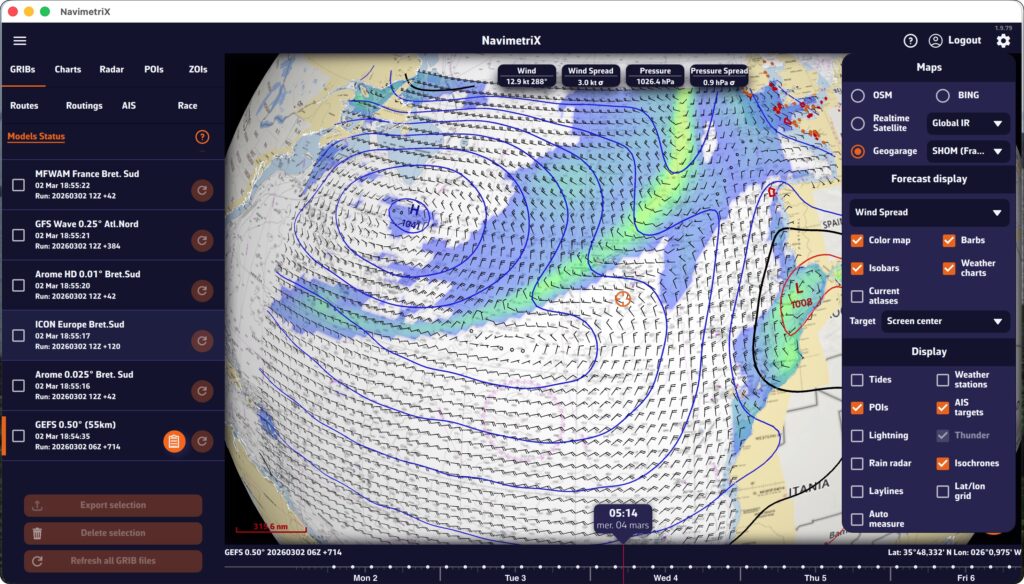
The average GEFS model provides, for each point on the grid, two information:
- The average wind (or pressure) value calculated over the 31 members.
- The spread: the dispersion around this average.
Statistically, there is approximately a 68% chance that the actual value will fall within the range “average ± 1 spread.” In other words, if the average is 15 knots with a 3 knots spread, there is about a 2 in 3 chance that the actual wind will be between 12 and 18 knots. A low spread means a reliable forecast; a high spread means a high degree of uncertainty.
Why it’s essential for navigation
While sailing, the weather determines your route, your speed, and your safety. Here’s what an ensemble model gives you in concrete terms:
1. Quantifying uncertainty
A classic deterministic model tells you: “15-knot wind.” An ensemble model tells you: “average wind speed of 15 knots, with a spread of 3 knots — so between 12 and 18 knots in 68% of cases.” This information is invaluable for choosing the right sails, planning a backup, or simply deciding whether it’s the right time to set sail.
2. Evaluate the reliability of your routing
Your weather routing gives you an optimal route — but this route is calculated based on a single scenario. What happens if the wind shifts 20°? If the low pressure system moves faster? Ensemble routing calculates the optimal route for each of 31 scenarios. If all routes pass through the same location, you can proceed with confidence. If they diverge, caution is advised.
3. Anticipate beyond 5-7 days
The reliability of a classic model declines rapidly after 5-7 days. The ensemble model, on the other hand, remains useful beyond that point, not because it predicts better, but because it shows you how uncertain the forecast is. When the 31 members diverge on D+7, you know it’s still too early to decide; that’s already very useful information!
GEFS in NavimetriX: easy and accessible
Until now, using an ensemble model was the stuff of professional meteorologists and offshore racing skippers. NavimetriX is changing that by making this data accessible to all sailors:
- Integrated download: the average GEFS model can be downloaded like any other GRIB file, directly from the application (select “Ensemble” from the GRIB request drop-down menu).
- Spread visualization: wind and pressure fields display their dispersion, allowing you to see at a glance where the forecast is reliable and where it is not.
- One-click ensemble routing: NavimetriX automatically downloads and calculates the 31 routes: no need to manipulate files or run scripts.
- Intuitive display: colored “spaghetti” routes and confidence corridor directly on the chart.
The ensemble model is no longer just for experts. It is a tool that helps all sailors make better decisions by transforming uncertainty into visual, clear, and usable information.