Polar efficiency and wind thresholds
ExpertThe essentials
A theoretical polar is often optimistic: it describes a well-tuned boat, with a trained crew, on flat sea. The efficiencies correct this without touching the polar: they are percentages applied to the polar’s speeds during routing. They are used only by weather routing.
- Open Settings, then “My Boat”. Under the “Polar” row, check the “Light wind threshold” (10 knots by default) and the “Strong wind threshold” (20 knots by default).
- Open Settings, then “Routing”. Under the “Polar” row, set the “Speed scale under … knots” (80% by default) and the “Speed scale over … knots” (90% by default). Their label repeats your two thresholds.
- If you reduce sail at night, also set the “Speed scale at night” (100% by default).
Going further
The settings
| Setting | Where | Values | Default |
|---|---|---|---|
| “Light wind threshold” | “My Boat”, under the polar | 0 to 30 knots | 10 knots |
| “Strong wind threshold” | “My Boat”, under the polar | 5 to 50 knots | 20 knots |
| “Speed scale under … knots” | “Routing” | 60 to 160% | 80% |
| “Speed scale over … knots” | “Routing” | 60 to 160% | 90% |
| “Speed scale at night” | “Routing” | 60 to 160% | 100% |
| “Minimum upwind angle” | “Routing” | 0 to 70° | 45° |
| “Maximum downwind angle” | “Routing” | 130 to 180° | 165° |
The thresholds are stored with the polar because they describe the boat; the efficiencies, with the routing.
How the efficiency is calculated
- Below the light wind threshold, the polar’s speed is multiplied by the “under” efficiency.
- Above the strong wind threshold, by the “over” efficiency.
- Between the two thresholds, the efficiency moves in a straight line from one to the other. By default, the efficiency is 80% up to 10 knots of wind, 90% from 20 knots, and it progresses in a straight line between the two: 85% at 15 knots. For example, at 12 knots: 80% + (12 − 10) ÷ (20 − 10) × (90% − 80%) = 82%. The thresholds and the efficiencies can be set (thresholds in Settings > “My Boat”).
- If you set the strong threshold equal to the light threshold (the app does not allow setting it below), the efficiency switches from one to the other at once, with no transition.
- At night, the night efficiency is multiplied with the previous one. Night here is nautical night, between nautical dusk and dawn, calculated for the position and time of each point of the routing. At 100%, it has no effect.
Other coefficients are added in some cases, always by multiplication: the slow zones’ speed factor (see ZOIs (zones of interest)) and the “Polar crossed sea efficiency” (see Routing settings).
The limit angles
Here again, theoretical polars are often optimistic. Example: the theoretical polar of a Sun Fast 3200 gives an optimal VMG angle close to 36° in 12 knots of wind (VMG is the speed made good along the wind axis). In practice, on flat sea offshore, this boat points on average at about 45°. So 45° is what you should enter as the minimum angle to the wind.
- “Minimum upwind angle” cuts the polar below this angle: the routing does not make the boat point closer to the wind. Useful when the polar promises an upwind heading your boat cannot hold.
- “Maximum downwind angle” prevents the routing from sailing deeper than this angle. It is mostly a matter of safety: offshore, you do not want to sail too deep (by default, not beyond a wind angle of 165°), to avoid gybes, especially under autopilot.
Setting your efficiencies
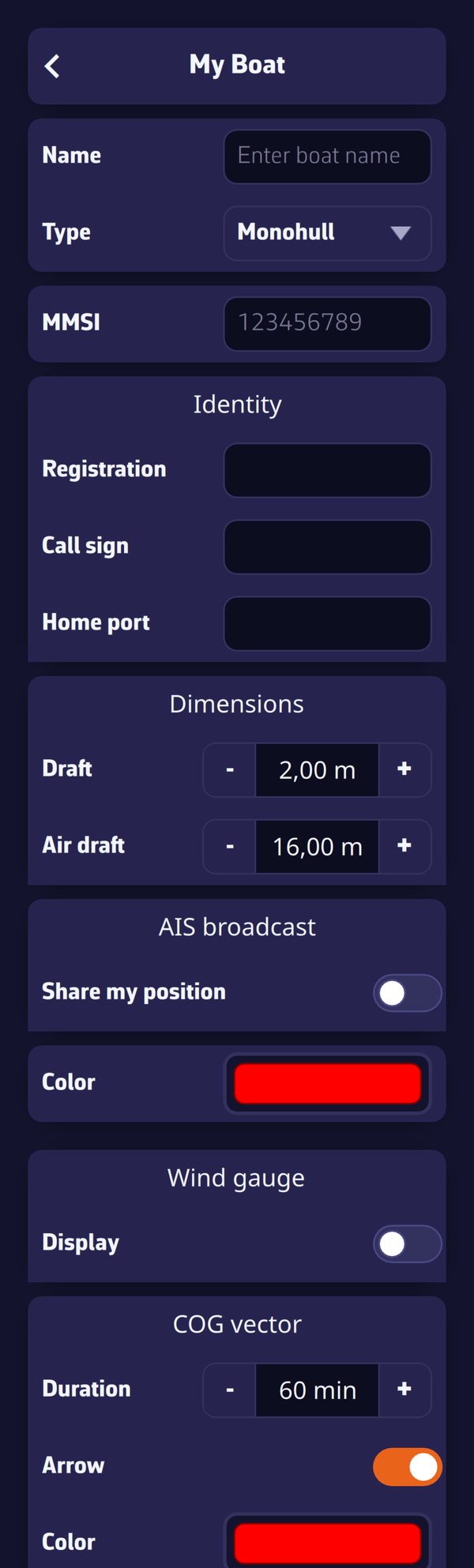 My Boat: the polar and the light wind and strong wind thresholds
Compare your real speeds with those of the polar, in light wind then in strong wind, and enter the average difference in the two efficiencies. Place the thresholds where your boat’s behaviour really changes: a light boat may leave its light-air regime earlier, a heavy boat later. The full method is described in Understand and choose your polar.
See also
- Understand and choose your polar
- Polar editor and Report: to correct the shape of the polar itself
- Routing settings: all the routing settings
- FAQ: How do I calculate a routing? What are the different settings?
- FAQ: How to work on your polar