Wind or depth can arrive from anywhere without any risk of confusion. The position, though, can only come from one link, otherwise the boat would jump from one point to another. You are the one who designates it.
In Settings (chevron handle ‹ on the right edge of the screen), GPS & NMEA, Advanced mode, tab GPS, the GPS source setting offers four choices. In standard mode it only offers two: Internal and NMEA.
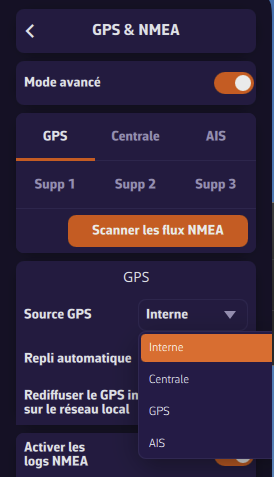
- Internal: the tablet's or phone's own GPS. On a Mac, which has no GPS, the "internal" position is derived from Wi-Fi or the IP address: it is never used for the boat in Navigation mode.
- Instruments: the position arrives mixed in with the instruments, which is the most common case.
- GPS: a dedicated GPS, usually more accurate and better placed.
- AIS: a transponder carrying its own GPS.
Automatic fallback
Automatic fallback is on by default, and best left that way. If the designated source goes quiet for too long (three times its usual rate, at least 10 seconds and at most 2 minutes), NavimetriX looks elsewhere rather than leaving you without a position: it tries, in order, the instruments, AIS, the dedicated GPS, additional links 1 to 3, then the device's own GPS. A banner tells you what it switched to, and another tells you when the original source came back.
Fallback only accepts a link that provides a real position. An AIS receiver with no GPS of its own, sending nothing but targets and a clock, is never chosen: it would freeze the boat instead of moving it.
Turning fallback off is only worth it if you want to see immediately that a GPS has failed, at the cost of losing the position. Under way, keeping it even degraded is nearly always better.